Technical SEO & Website Performance
Technical SEO and website performance optimization.
Evidence-led improvements to crawlability, indexing signals, metadata, internal links, page performance, and the journey from content to enquiry.
The scope
Make the next step practical.
Technical SEO starts with evidence about the public website and the important pages it needs people to find. The review examines response behavior, crawl controls, canonical URLs, sitemap coverage, metadata, internal links, structured data, and the relationship between published content and the CMS.
Performance work follows the affected user journey. A slow main image, delayed interaction, unstable layout, or unnecessary third-party script needs a different repair. Where real-user or Search Console evidence is available, it is used alongside repeatable page checks to prioritize work rather than treating every automated warning as equally important.
On-page improvements connect the visitor's question to a useful answer and a relevant next step. That can include clearer service scope, better page titles, more descriptive internal links, and stronger case-study presentation. Off-page opportunities focus on useful resources and legitimate professional references; purchased links, fabricated reviews, and ranking guarantees are not part of the service.
What you receive
Deliverables you
can put to use.
- A prioritized review of important pages and generated discovery routes
- Repairs to agreed metadata, canonical, indexing, and internal-link issues
- Targeted performance improvements supported by measurements
- Clearer on-page service content and enquiry pathways
- Verification evidence and a plan for observing search performance after release
How we work
From first conversation to handover.
Establish what matters
Identify business-critical pages and inspect available search, publishing, performance, and enquiry evidence.
Repair the priority issues
Implement the agreed fixes, keeping visible pages and generated routes consistent.
Verify and observe
Check the deployed result and compare subsequent search evidence over suitable reporting windows.
Selected work
See the implementation.
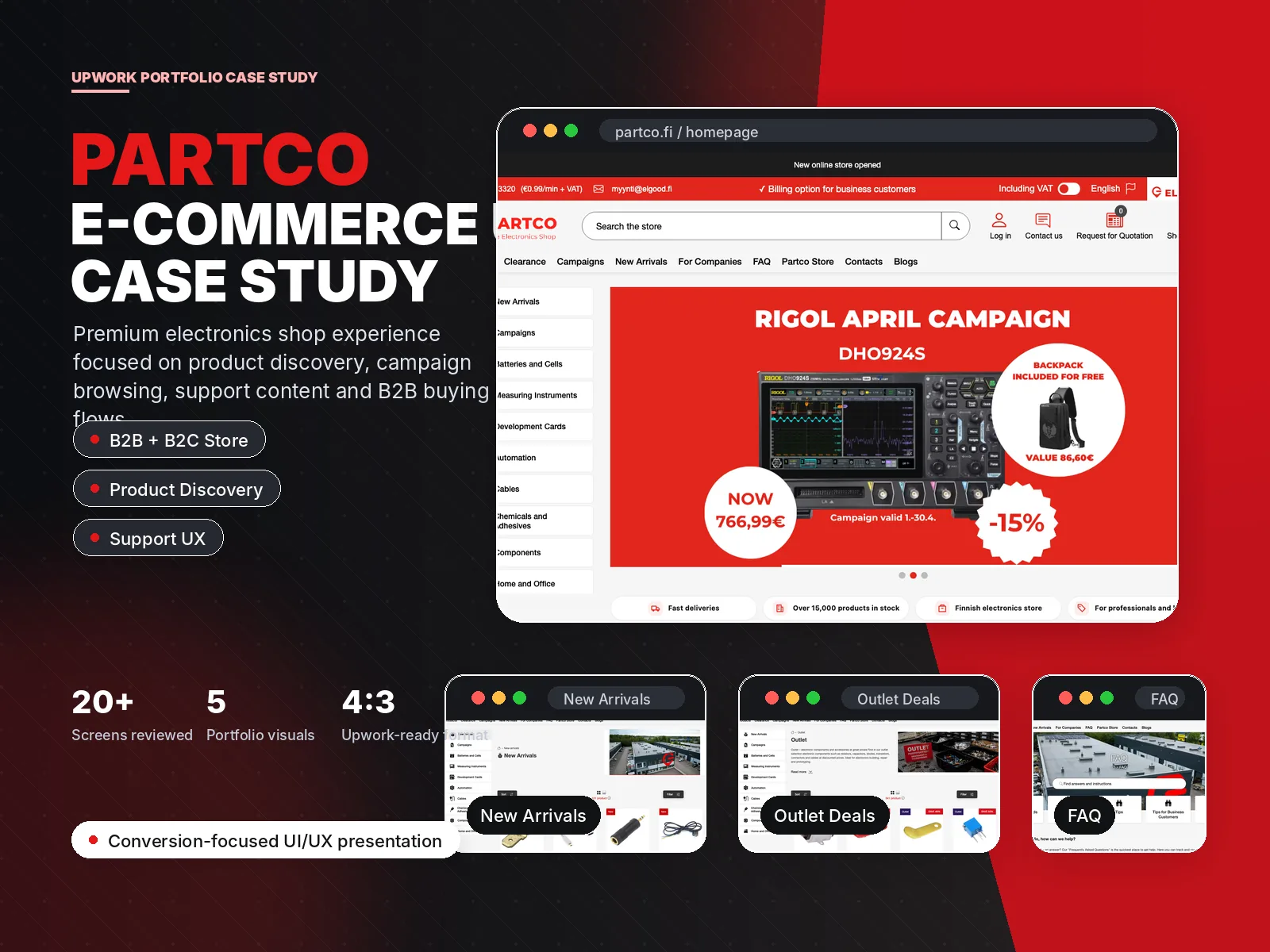
Partco Electronics Store
Premium electronics ecommerce UI/UX focused on fast product discovery, B2B buying flows, campaigns, outlet deals, and conversion-focused catalog navigation.

LedStore.fi — Ecommerce UI/UX, Product Catalog & Service Experience
I worked on LedStore.fi, a Finnish LED lighting ecommerce website, and helped shape a professional digital experience that combines online shopping, service discovery, and customer education.
Related services.
Explore adjacent work when your project needs more than one scope.
Before you start
Useful answers.
Can an English website target US, UK and European clients?
Yes. Useful English service pages can serve international buyers when the offer, examples and remote enquiry process are relevant to them. Use real business details and consistent canonical URLs. Translated or region-specific pages should be added only when there is substantive content for that audience; geography keywords alone do not establish relevance.
Can you guarantee a number-one ranking?
No. Search rankings and lead volume cannot be guaranteed. The work improves specific technical, content, and user-experience foundations and measures the result honestly.
Will you fix every page marked not indexed?
Not every exclusion is an error. Duplicates, redirects, filters, and intentionally unavailable pages can be correctly excluded. Important canonical pages are reviewed against the actual reported reason.
What access is useful for an SEO review?
Search Console access, the public site, relevant CMS or repository access, and available analytics can help. Sensitive credentials should be shared through approved account access methods, not the enquiry form.
Practical reading
Explore the details.
Technical SEO Audit vs Monthly SEO: Which Service Do You Need?
Choose between a technical SEO audit, implementation work and ongoing SEO using your indexing evidence, content readiness and business enquiry journey.
Technical SEO Audit for Small Business Websites: Prioritize What Blocks Users
A small-business technical SEO audit should prioritize problems that block access, discovery, or conversion. A long export of warnings is not a repair plan....
Core Web Vitals Optimization: Prioritize LCP, INP and CLS by User Impact
Prioritize Core Web Vitals work by identifying which user experience is slow or unstable and which pages affect the business most. A single lab score does...
Your next step
Let’s define a useful scope.
Tell me what you use, what needs attention and what a successful outcome looks like.